Wednesday, November 9, 2022

How Do People Age?

What age would you like your loved one? This is one of the first questions I ask in a sculpture commission. It is essential to know what they expect. There was one commission where the son brought his dad to my studio. The dad was in his late 60's. I took photographs all around the subject. Taking photographs all around helps me to be able to create a sculpture that looks like the subject from all sides. I made an exact likeness, and when I showed the son, he said, "that is not what I want." I showed him the pictures against the artwork, and he said, indeed, I had done my job, but he really wanted an image of his dad as he remembers him. 


What? 

That is a different story entirely. So, he sent pictures of his dad, my client, and the subject's son was in the photos. He is about 7 or 8 years old in those photographs. I guess we remember our parents at a certain age. and that is what he did. So, I had to de-age the sculpture. 


I have studied aging in detail in something called forensic art. It is a fascinating process. 


What does that mean? Well, it is a well-known fact that our noses and ears get longer as we age. EWWW what? Yep, it is one of the reasons I don't wear earrings. I don't want anything to pull those ears down any more than gravity and nature will. Watch this video by Marc Brunet about the aging of a face. 


Here is a cool piece of art that shows a subject's aging as you walk around it. It is fascinating to watch, and I wish I could see it in person. According to My Modern Met, creating this art is not done digitally but traditional painting but done on strips. The one likeness is painting on one side of the strip and the other on the other side. Fascinating. 


For anyone interested in learning Forensic Art the book by Karen Taylor is wonderful. 


Tuesday, November 1, 2022

Reference of a Man

What type of reference do I need for a subject? In a perfect world, I would have images of my subject all the way around them at the age I am going to sculpt them. That is only possible in a commission where the person is alive, and I have access to them. I would even take photographs from the top and the bottom. In many cases, such as Booker T Washington, I don't have access to them, and I have to count on what I can find, or what the family can send. I have a saying, "You can never have too many references."


Reference is so essential. In the past, sculptors would ask if they could do a plaster cast of their model. If the subject were recently deceased, they would try to do a plaster right after they died to preserve the likeness. The updated version of that would be a 3D scan. I have had my face 3D scanned quite often. The difficulty is that 3D scanners are expensive and not readily available. 

Here is a funny thing: I was not sure I was really an artist when I was younger. I could not draw from my head and needed a reference or something in front of me. 


My first commission as an artist was actually in kindergarten. My teacher saw some promise in me and asked me to do the Christmas hall bulletin board of Santa and his reindeer. I was excited she noticed,  but it brought me to tears, and finally, I admitted to the teacher that I didn't know how reindeer looked enough to draw them. She then said, Oh, I can help with that. I'll get you a picture. This really confused my kindergarten brain. If the teacher had photos of a reindeer, why did she need me?

I have since learned that not only do artists use references, but sometimes they trace things. When I grew up, there were no computers or the internet. Now it is very easy to find just about anything you want. But back then, artists saved pictures in a file cabinet. It was called their artist morgue. 

Today, I use Pinterest and put images up on google drive for myself and my interns to use. 


Well, it took a long time to get images from the family. I try to be a detective, and if the person is well-known, I can find what I need. Plus, seeing a person's images helps me capture more than a likeness. It is the essence of the spirit of the person that I am after. 

How excited I was to find a digital memorial that someone put up where family-added images. I got to see my subject in all stages of life. This gives me a bond with him. I hope the link is good throughout this commission. I love going there. 

Sunday, October 23, 2022

A Model/Models- Reference


As I stated, reference is a big part of creating good art. First, my friend Antwine posed so we could quickly see how tall a seated man would be, that is the approximate height of our subject. 

Mr. Tough was 5'10" Next, I posted on my neighborhood Facebook page to look for a man with the same build and height as my subject. That was hard. First, I thought we were doing him much older, and then I received word I should sculpt him in his 50's. I had to have my client define what image they might have that depicts Mr. Tough in his 50's, and we started all over again, looking for another model and creating our reference.  


Often when sculpting a deceased loved one, I prefer to have a member of the family pose in the pose if they are about the same height and stature. But things have been going slow with communication, and we need to get going on the project, so I opted for a stranger. I posted on my neighborhood forum to find a man, and neighbors sent me images. I opted for a man younger than 50 and a bit thinner, but we can thicken him up. I'm also noting Mr. Toughs stature or how he should sit or stand. This stature won't change over years, or if it does, it will change only slightly. That is where having lots of reference material for my subject is important. 


I set up my model on my bench and took photographs around him, from above and even underneath the bench. These photographs will show me the folds in his suit and how it fits and allow me to refer back to these images for shape and positioning. Here is the thing. If Mr. Tough is in his 50's, his suit would be from that time period. So, I spent a great deal of time trying to figure out what type of suit he would be in and how the design changed from my model's suit. My model's suit is very tight, so loosening up that suit will be a priority, the suit will have larger lapels and he will wear a wider tie. 


I often spend a great deal of time researching clothes, for example, the suit of Booker T Washington, or in the case of my newsboy sculpture, I found a pattern from the period, sewed the outfit, and had my model pose with it on. (FYI, old patterns do not have the same markings as new patterns. This made sewing a bit challenging, but it was fun.) 

I'm getting very excited about getting my hands in the clay. Stay tuned. 


Teachers and students

How do you think the study of clothing and understanding what people wear at certain times in history relates to what is happening in the world? 


What did your parents wear, and how was their clothing different? 


Does the style of clothing change? What is your favorite style of clothing from the past? 

How have school clothes changed over the years? Did you know there was a time when girls could not wear pants to school and boys had to wear hats or ties? When I sculpted the newsboy, I was surprised to learn about the knickers he wore, and if you wore them above the knee, they meant you were young and below the knee meant you were older. There was even a line in a famous musical about if your son buttoned his knickers below the knee- it was sung as if doing so he would be rebellious. Clothes can say a lot. 

Monday, October 17, 2022

Have a seat

 Those visiting the sculpture will not only be able to look, but they will be able to have a seat. The bench is ready. We have had the bench that the sculpture will sit on for quite some time. We needed it to be able to design around it. Though the bench is wood now, it will be a bronze bench in the end. Wood benches often can't hold a bronze sculpture's weight without reinforcing and don't last as long as bronze. We will make a mold of this wooden bench and turn it into bronze. You will learn about that later, but for now, we must protect it so that it can withstand the process of mold-making later and also that the clay will not stick to the bench. So my intern stained, sealed, and wrapped it in saran wrap to protect it.  


Teachers and Students

I know our bench is important, but then I wondered, what are the most famous chairs in history?  I'm very curious by nature, and found a blog post about famous chairs.  I have had fun with chairs over the years. Here are some of mine. 

  • Booker T. Larger than life Chair. I wrote an article  about this.  Does a chair have a personality? 
  • The rocking chair in my sculpture at Dallas Baptist University was actually the deans chair. He spent many days praying on that rocking chair. My favorite view is one no one will ever see. It is without the back of the chair. 
  • Then of course there is the Mad Hatter Chair. Have you seen it? There are lots of hidden messages in that chair. 
    I created the hatter chair with many different references. I love creating a chair out of my head.  We also made it using digital technology. Here is a video from the cnc company that helped make the hatter's chair. 
  • let's not forget Alice's chair. Hiding things in that chair was so much fun, and I love sitting next to Alice. 


Sunday, October 2, 2022

How Does An Artist Learn About Someone She Does Not Know?


That is interesting because that is the very same question that artist Bridgette Mongeon asks when she starts this process. So she becomes a detective of sorts, searching the internet, asking family, and finding out who this incredible man is and why people want to honor him. You will learn as she learns. 

A great deal of capturing a person's emotion depends on the stories of the family and friends. The more she can hear about the person, the better the sculpture will be.


 So, if you knew Mr. Tough and are reading this blog, please share your stories. 


Bridgette loves learning about people. She finds it very interesting to see where their paths lead in life and what brought them to where they are or their accomplishments. She was in grade school when she first learned she could find books called biographies. She first read about Lincoln because she thought he had an interesting face and seemed kind. George Washington Carver was another she read as a child. She was interested in how one person could find over 300 uses for peanuts. That is clever. The day she found the biography section in the library, she flipped! She could learn about all the people. 


Questions for Teachers and Students. 

  • Have you read a biography?
  • Why do you think people write biographies? 
  • What is the difference between a biography and an autobiography? 
  • Have you heard of a memoir? How is a memoir different than an autobiography? 
  • You could say that the book the artist is helping her granddaughter write Issa's Grand Adventures: Book One- Texas State Parks, is her granddaughter's memoir. It is her experiences in the Texas State Parks. People write memoirs about their own experiences. If you were to write a memoir about an experience, what would it be? 

 While searching the internet, she found a video of Mr. Tough reading to children. "I love this," says the artist, "I love it for a few different reasons. The first is anatomical. I can see how his body moves and his facial features. But more importantly, I can see his smile and his interaction, and he becomes more alive to me. I hope I can receive more videos from family and friends. " Here is the link to Mr. Tough reading. 

Saturday, October 1, 2022

Comparisons

Creating a sculpture or even a real-life drawing is all about comparisons. Bridgette says that all art is about comparing. You compare one thing to another. The size of a hand compared to the length of the arm, compared to the size of the chest. Many famous artists and one, in particular, was very interested in comparing. He wrote notebooks about it. Leonardo Davinci spent a lot of time noticing things. Have you ever done that? For example, sitting in your class, you might notice that the blackboard height is almost one-half of the room's height. ( I made that up. ) Or there are 24 tiles across the ceiling in the math classroom. Davinci noticed EVERYTHING, and he put it down in notebooks. You can't help but wonder if Mr. Tough ever read Davinci's notebooks. There is a lot about architecture in there. 


Bridgette will use some of these comparisons herself. How many heads high is her subject? Did you know that if you put the line in your wrist at your chin and your hand is straight, your middle finger will reach your hairline? This helps not to make hands too small or too big when sculpting. 


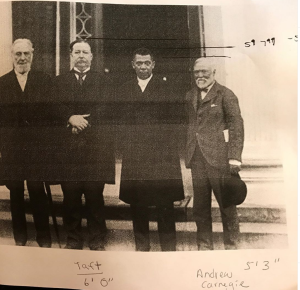
Bridgette keeps notes on the different people as she sculpts them. She also has to learn and research the people that her subject knew. For example, when creating a recent monumental sculpture of Booker T. Washington. She had to know how tall he was. Booker T. lived a long time before Mr. Tough, and his height was nowhere to be found in her research. So how do you find out how tall someone is that lived over 100 years ago? She found a photograph of Booker T. with other influential men. For example, in this picture, President Taft was six feet, and Andrew Carnegie was Five feet three. So she could compare and find that Booker T. Washington was about five feet seven inches tall. Wasn't that fun? She truly is a detective. 


For Teachers and Students. 

  • How many heads high are you? 
  • Have you compared things? What did you compare, and what did you find? 

Here is a video of how to measure proportions of things. The two hints are- keep your arm straight and close one eye when looking. Watch how this person finds out how many widths of the bottle fit in the height- from his perspective. 


Tuesday, September 27, 2022

STEAM Education


Bridgette works with many different tools that most artists don't. She uses 3D printing, 3D scanning, and CNC milling in her work. She even wrote a book about it. She loves talking to children about STEAM education, especially regarding her Alice Sculpture. Below are two videos. The first is an introduction to the Texas Art Educators Conference. Bridgette was chosen to speak there about STEAM. The second is a video of her speaking at Young Women in Math and Science- Expanding your Horizons. If you watch the video at about 11 minutes, you can see a CNC machine milling out a body of the March Hare. This is how Bridgette Makes things big. Watch at 13 minutes, and you will see one of the hidden 150 things—something that is both in Bridgette's artwork and in the movie Toy Story and even in the Simpsons. 


STEM education came about because the schools and the government were finding that fewer students were going into Science, Technology, Engineering, and Math STEM. So they wanted to encourage students in school to study these subjects. Bridgette adds the A to STEM to make it STEAM. Art can inform other subjects. She wants to encourage young people, especially girls, to go into these areas of study. 

Texas Art Educators introduces Bridgette Mongeon

Exploring Your Horizons in Math in Science. 


This last video has an interview with a young girl who also wants to encourage girls to get into technology. Watch this video to see how the sculptor creates in the computer. Also watch through to meet Coco. She is an 11 year old girl who built a 3D printer. 


For Teachers and Students
  • Why do you think students were not studying the subjects in STEM or STEAM? 
  • How can you make these subjects fun? 
  • Do you remember the artists post about baseball and interdisciplinary study? 
  • Do you think the hidden 150 thing shown at 13 minutes in the video is interesting? Have you ever seen it elsewhere?  
  • What type of STEAM do you think Coulson Tough used in building your school or other things? 


Covering the body with clay

The posts for this blog will get fewer now that we are knee-deep in the clay. Our job is to take that foam armature and make it look like a ...